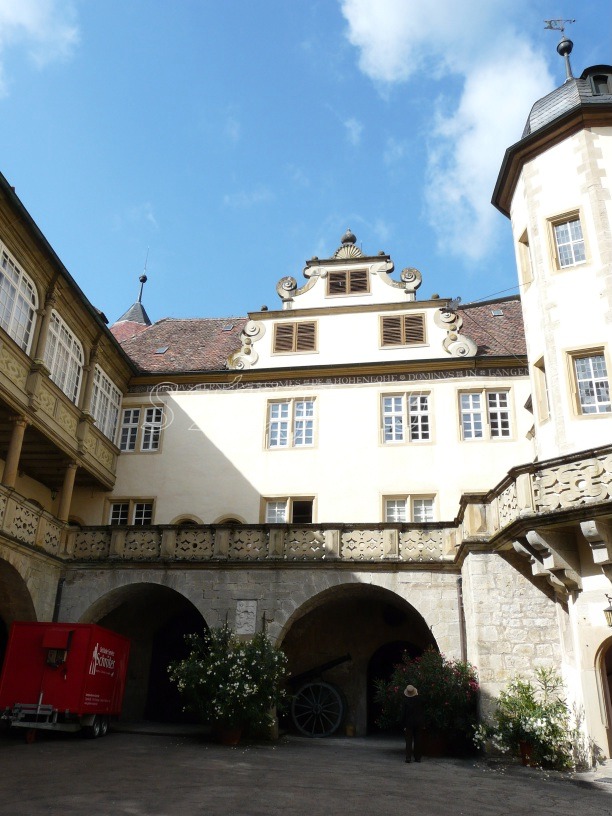
The Monastery Bebenhausen was a Cistercian monastery in Bebenhausen whoch is today a part of Tübingen. After the Reformation whioch took place in Württemberg in 1534 the monastery served as a convent school, hunting palace of the Kings of Württemberg and the seat of the parliament of the state of Württemberg-Hohenzollern.
The monastery was founded at the end of the 12th Century by Count Palatine Rudolf of Tübingen. A barter with the Diocese of Speyer was a prerequisite by Count Palatinate Rudolf I of Tübingen (1182-1219) "for the purpose of his salvation" probably in 1183 donated to the village monastery Bebenhausen. Rudolf gave the bishopric of Speyer St. Martin's Church in Meimsheim and received the necessary foundation for the monastery lands. The donation was certified in 1188 by the Bishop of Speyer and 29 June 1193 by Emperor Heinrich VI. confirmed. The construction of the monastery in the 1180s-years was probably not progressing as quickly as a document of the Swabian Duke Friedrich V. of 1187 proves, in which he law of the Congregation of the logging in the kingdom of the Forest Book and Others securitized for buildings. The monastery was - according to the design earthquake Stockhausen as burial side for the Palatinate Count's family - first settled by Prämonstratenserchorherren, they could have come from Marchtal. Before 1189/1190 Premonstratensian left Bebenhausen, and first twelve Cistercian monks of the monastery of Schönau (near Heidelberg) under the found Abot Diepoldsberg settled there after the request of the Count Palatine Rudolf in Citeaux the localities under investigation Commission and the General Chapter was met positively. Bebenhausen was among Schönnau and Eberbach to the filiation of the mother abbey of Clairvaux. Only under the Cistercians began the actual construction and expansion of monasteries and monastic buildings. Anyway medieval sources report at the beginning of the 13th Century by a difficult economic situation that gripped the monastery despite extensive donations and goods donations. But counted the monastic community at the end of the 13th Century, up to 80 monks and 130 lay brothers (lay brothers) and was in the course of the late Middle Ages to the richest monasteries of Württemberg. As a Cistercian monastery Bebenhausen possessed according to the High Middle Ages libertas ecclesie no Vogt, therefore lacked - in theory - the screen by a mighty rulers. This protection practiced for many Cistercian monasteries the (staufian) Kin, g for Bebenhausen it was the Count Palatine of Tübingen, which had as its founding family the umbrella over the monastery. In the late Middle Ages, transformed into protection (protective) rule. Also Bebenhausen was now involved in the Count Palatinate state government, which was in turn sold or pledged in 1342 to the Counts of Württemberg. Of these, the zisterze was also affected, but Bebenhausen was triggered temporarily in 1361 by Emperor Karl IV. But in the long evaded Empire Empire binding and relative immediacy of the monastery of the country's rule of the Counts and Dukes of Württemberg. In the course of the second Half of the 15th Century reinforced the Landsässigkeit zisterze the shaft up to the country level. Bebenhausen became a prelate Württemberg monastery belonged to the Estates within the Duchy and was represented since 1498 in the Württembergian Parliament. As for a Habsburg interlude (1519-1534) Duke Ulrich I of Württemberg (1498-1550) was the reconquest of its territory succeeded, he introduced in his prelate monasteries the Reformation (1534). Bebenhausen was also affected, the Catholic monastic period was coming to an end after the 1525 zisterze had already taken damage during the Peasants' War.
After the Reformation in Bebenhausen the monks, who held to the old faith went - it was about half of 36 brothers - to Stams in Tyrol or Tennenbach in the Breisgau. Catholic monks should return to Bebenhausen twice: during the Augsburg Interim (1548) by Abbot Sebastian Lutz (1547-1560), who was the last Catholic abbot and with Eberhard Bidembach followed the first Protestant abbot, and during the Thirty Years' War (1618-1648) and from 1629 to 1632 back to 1634. After the Peace of Westphalia (1648) it was over to the Catholic convent in Bebenhausen. Already in 1556 had been set as in twelve other men Württemberg monasteries a Protestant monastery school. Many prominent personalities attended these schools in Bebenhausen about the philosopher Friedrich Wilhelm Joseph Schelling. The school was united in 1807 with the convent school in Maulbronn. The Protestant monastery was secularized in 1806
 monasteries and monastic buildings. Anyway medieval sources report at the beginning of the 13th Century by a difficult economic situation that gripped the monastery despite extensive donations and goods donations. But counted the monastic community at the end of the 13th Century, up to 80 monks and 130 lay brothers (lay brothers) and was in the course of the late Middle Ages to the richest monasteries of Württemberg. As a Cistercian monastery Bebenhausen possessed according to the High Middle Ages libertas ecclesie no Vogt, therefore lacked - in theory - the screen by a mighty rulers. This protection practiced for many Cistercian monasteries the (staufian) Kin, g for Bebenhausen it was the Count Palatine of Tübingen, which had as its founding family the umbrella over the monastery. In the late Middle Ages, transformed into protection (protective) rule. Also Bebenhausen was now involved in the Count Palatinate state government, which was in turn sold or pledged in 1342 to the Counts of Württemberg. Of these, the zisterze was also affected, but Bebenhausen was triggered temporarily in 1361 by Emperor Karl IV. But in the long evaded Empire Empire binding and relative immediacy of the monastery of the country's rule of the Counts and Dukes of Württemberg. In the course of the second Half of the 15th Century reinforced the Landsässigkeit zisterze the shaft up to the country level. Bebenhausen became a prelate Württemberg monastery belonged to the Estates within the Duchy and was represented since 1498 in the Württembergian Parliament. As for a Habsburg interlude (1519-1534) Duke Ulrich I of Württemberg (1498-1550) was the reconquest of its territory succeeded, he introduced in his prelate monasteries the Reformation (1534). Bebenhausen was also affected, the Catholic monastic period was coming to an end after the 1525 zisterze had already taken damage during the Peasants' War.
 After the Reformation in Bebenhausen the monks, who held to the old faith went - it was about half of 36 brothers - to Stams in Tyrol or Tennenbach in the Breisgau. Catholic monks should return to Bebenhausen twice: during the Augsburg Interim (1548) by Abbot Sebastian Lutz (1547-1560), who was the last Catholic abbot and with Eberhard Bidembach followed the first Protestant abbot, and during the Thirty Years' War (1618-1648) and from 1629 to 1632 back to 1634. After the Peace of Westphalia (1648) it was over to the Catholic convent in Bebenhausen. Already in 1556 had been set as in twelve other men Württemberg monasteries a Protestant monastery school. Many prominent personalities attended these schools in Bebenhausen about the philosopher Friedrich Wilhelm Joseph Schelling. The school was united in 1807 with the convent school in Maulbronn. The Protestant monastery was secularized in 1806
 Since the monastery is located direct at the beauitful Schönbuch a vast forest and hunting area the rulers of Württemberg first used the abbot's house of the formers monastery as a hunting lodge. In 1812, King Frederick of Württemberg held here the "Diane Festival" from where hundreds of captive animals driven past in front of the court and were shot down. Beginning in 1864, the monastery buildings to the east of the seclusion where used as Castle.
When King Wilhelm III of Württemberg left Stuttgart on 09.22.2928 he and Queen Charlotte went to Bebenhausen Castle where he abicated on 30.11.1918. He and Queen Charlotte where the right to lieve there for the Rest of their life. King Wilhelm II.died at Benhausen in October 1921 where he lay in state before being brought to Luwgsburg where he was buried at the Old burial ground. Queen Charlotte lived at Bebenhausen until her death in July 1946.

After the Second World War, parliament and constitution of the state of Württemberg-Hohenzollern were justified in Bebenhausen. Parts of the plant department were used as an archive, deposit and state of the state of Württemberg-Hohenzollern until 1952.